

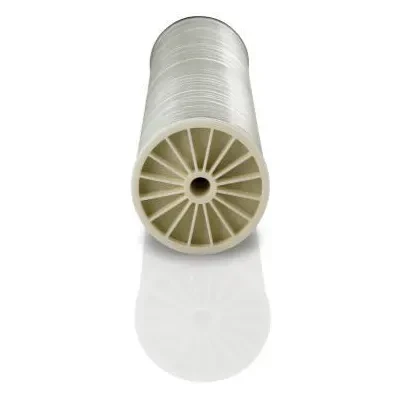
DuPont Nanofiltration MembraneNF270-400/34i
DuPont
High-flux nanofiltration elements for groundwater softening and surface water organic removal, operating at lower pressure than reverse osmosis.

DuPont Nanofiltration Element NF1000 HP
High ion-selective nanofiltration elements designed for industrial near-zero discharge, resource recovery, and water softening applications; they reduce the volume of concentrated brine requiring downstream thermal treatment.
| Parameter Item | Parameter Value |
|---|---|
| Effective membrane area | 37 m² (400 ft²) |
| Inlet screen thickness | 34 mi |
| Product Water Flow | 31 m³/d (8,200 gpd) |
| Stable desalination rate | 99.2% |
| Minimum Desalination Rate | 98.0% |
| Diaphragm Type | Piperazine-amide composite membrane |
| Maximum Operating Temperature | 45 ℃(113 ℉) |
| Maximum Operating Pressure | 83 bar (1,200 psi) |
| Maximum voltage drop per component | 1.0 bar (15 psi) |
| Maximum Pressure Drop for Pressure Vessels | 3.5 bar (50 psi, minimum 4 elements) |
| Continuous pH range | 3 - 10 |
| Short-term cleaning pH range | 1 - 12 (30 minutes) |
| Maximum Inlet Flow Rate | 17 m³/h (75 gpm) |
| Maximum Inlet SDI15 | 5 |
| Free Chlorine Tolerance | < 0.1 ppm |
| Component Dimensions (A Length / B Diameter / C Permeate Side Inner Diameter) | 1,016 mm (40.0 in) / 201 mm (7.9 in) / 29 mm ID (1.125 in) |
| Standard Test Conditions | 2,000 ppm MgSO₄, 4.8 bar (70 psi), 25 °C, 15% recovery |
Complete system flushing and pressure vessel inspection prior to commissioning, ensuring seals are properly installed. Set initial production capacity according to the manufacturer's recommended flux during startup, and record the initial operating pressure, production volume, and product water conductivity as baselines for future performance comparison.
Maintain feedwater SDI15 within specifications during operation to avoid prolonged operation under excessive design pressure. For extended shutdowns, properly protect and flush the membrane elements to prevent microbial growth. If permeate flow decreases or differential pressure increases, first identify the fouling type before selecting the appropriate cleaning chemicals and procedures.
For performance evaluation or cleaning recommendations, please provide system operation data (operating pressure, permeate flow rate, permeate conductivity, and cleaning records) for technical team analysis.
Specify the raw water type, production capacity, and target water quality. Our technicians will provide configuration recommendations and a quote based on your project requirements.

Scan QR code to add on WeChat
DuPont Nanofiltration MembraneDuPont
High-flux nanofiltration elements for groundwater softening and surface water organic removal, operating at lower pressure than reverse osmosis.
DuPont Nanofiltration MembraneDuPont
High-rejection nanofiltration element designed for feedwater applications requiring stricter control of hardness and trace organic contaminants.
DuPont Nanofiltration MembraneDuPont
4-inch NF membrane element for small to medium-sized softening and separation systems.